For a quarter century, Sri Lanka seems to have been plagued by misfortune, including a brutal civil war between the government and a separatist Tamil group. But the conflict finally ended last May, ushering in a more peaceful era for this teardrop-shaped island off India’s coast, rich in natural beauty and cultural splendors.
The island, with a population of just 20 million, feels like one big tropical zoo: elephants roam freely, water buffaloes idle in paddy fields and monkeys swing from trees. And then there’s the pristine coastline. The miles of sugary white sand flanked by bamboo groves that were off-limits to most visitors until recently are a happy, if unintended byproduct of the war.

Sunday, April 4, 2010

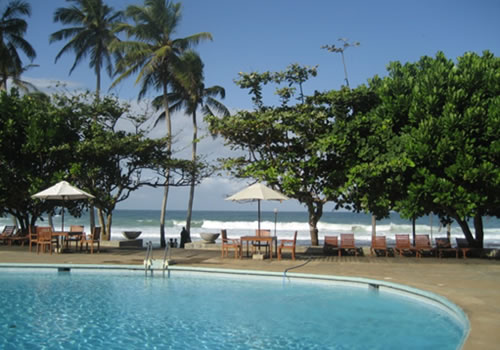
Amaya Reef - Hikkaduwa

Overlook the Indian Ocean from your balcony or terrace. Every one of Amaya Reef's 54 rooms features an ocean view, and each offers individual design.
Simplicity. Clean design that allows you to enjoy the natural setting. Ocean breezes. Sri Lankan sunsets. A comfortable space of your own to enjoy the beauty of Hikkaduwa.
The Setting
On golden sands. Amaya Reef is located 100 km south of Colombo at Hikkaduwa beach. Ideal for days spent lazing by the ocean, exploring the sea, diving shipwrecks or snorkelling the reef.
Accommodation
Amaya Reef offers 54 rooms – comfortable, air-conditioned and clean design allowing guests to enjoy the natural setting. Each room features a private balcony or terrace with views of the Indian Ocean.
                                                                 
                                                                 Seaside Restaurant
Fresh seafood with exquisite flavours and local touches. Covered open-air restaurant located along the beach. Serving Sri Lankan style grilled lobster, tiger prawns, a variety of fish, local curries and international cuisine. 

                                                                    Open-Air Bars
Located in a quiet corner of the resort between the main building and the seaside restaurant. Seating at the bar or at tables beneath the palm trees. Serving a selection of cocktails, beers, wines, shooters and mixed drinks made with the strong local coconut liquor arrack.

 Recreation                                                           
  • Swimming Pool                                                       
  • Ayurvedic Spa Treatments
  • Nightclub 
  • Tennis
  • Table Tennis
  • Beach Volleyball
  • Basketball
  • Badminton
  • Surfing
  • Water Polo                                
  • Boat Rides
  • Beach Rugby
  • Indoor Games


 Excursions 
  • Galle City and Dutch Fort
  • Martin Wickramasinghe Folk Museum , Koggala
  • Stilt Fishing at Ahangama
  • Sinharaja Rainforest
  • Madu Ganga Safari in Balapitaya
  • Turtle Hatchery in Kosgoda
  • Watersports at Bentota                                   
  • Deep Sea Catamaran Fishing
  • Train Tour to Matara
  • Moonstone Mine at Meetiyagoda
Services
  • Room Service
  • Foreign Currency Exchange
  • Laundry Service
  • IDD Facilities
  • Safety Lockers 
Diving & Snorkelling
Amaya Reef arranges snorkelling excursions, bringing guests to the attraction that lends the resort its name. The resort also helps guests to book diving trips that capture the highlights of the southern coast. PADI certification courses available. 
 
Meetings & Events
Amaya Reef's 2,200 sq.ft. air-conditioned conference hall accommodates groups of up to 110 persons. An ideal venue for meetings, banquets, events and corporate retreats.


Saturday, April 3, 2010

Gal Viharaya-Polonnaruwa

The Gal Vihara (Sinhala: ගල් විහාරය), also known as Gal Viharaya, is a rock temple of the Buddha situated in the ancient city of Polonnaruwa in north-central Sri Lanka. It was constructed in the 12th century by Parakramabahu I. The central feature of the shrine are four images of the Buddha, which have been carved into the face of a large granite rock. The images consist of a large seated figure, another, smaller seated figure inside an artificial cavern, and standing figure and a reclining figure. These are considered to be some of the best examples of ancient Sinhalese sculpting and carving arts, and have made the Gal Vihara one of the most visited monuments in Polonnaruwa.
The images of Gal Vihara follow a different style than the images of the previous Anuradhapura period, and show some significant differences. The identity of the standing image is subject to a certain amount of dispute among historians and archaeologists, some of whom argue that it depicts the monk Ananda rather than the Buddha. Each of the images have been carved in a way that uses a maximum possible area of the rock, and their heights seem to have been decided based on the height of the rock itself. Each statue appears to have had its own image house, as indicated by the remains of brick walls at the site. The Gal Vihara, or Uttararama as it was known during that period, was where Parakramabahu I held a congregation of monks to purify the Buddhist priesthood, and later drew up a code of conduct for them. This code of conduct has been recorded in an inscription on the same rock face containing the images of the Buddha.

Uttararama

The Gal Vihara, or rock temple (so named after the large rock face where the four images of the Buddha were carved), was originally named Uttararama (the northern monastery), in the city of Polonnaruwa, and according to the chronicle Chulavamsa was one of the more prominent of the 100 temples built throughout ancient Sri Lanka by King Parakramabahu I (1153 – 1186).The chronicle mentions that Parakramabahu I had his workmen build three caves in the rock after finishing the temple: the Vijjadhara Guha (cave of the spirits of knowledge), the Nissina Patima Lena (cave of the sitting image), and the Nipanna Patima Guha (cave of the sleeping image). Although they are described as "caves", only the Vijjadhara Guha is a cave, while the others were image houses similar to the Thivanka and Lankathilaka, with their walls connected to the rock face. These walls, which were evidently decorated with frescoes,have since been destroyed and only their bases now remain,
By the time Parakramabahu I ascended to the throne, the Buddhist priesthood in the country was divided into three fraternities: Abhayagiri, Jetavana and Mahavihara. He held a congregation of monks to reconcile the three fraternities, and "purified the order" by expelling corrupt monks. With the help of the elders of each fraternity, he later drew up a katikavata (code of conduct) for Buddhist monks and recorded this in an inscription at Uttararama. The area in front of the images, which now resembles a terrace, is believed to be the location of the assembly hall where this congregation was held. The inscription recording the code has been carved on the flat, polished rock face between the Vijjadhara Guha and the standing image. The Uttararama was abandoned during the fall of the Polonnaruwa Kingdom. It had functioned as an educational establishment from its inception to its abandonment, being a centre of Buddhist education in the country.

Seated image

The large seated image is 15 feet 2.5 inches (4.635 m) tall, and depicts the dhyana mudra. The seat was carved in the shape of a lotus flower, its base decorated with carvings of flowers and lions. The statue sits on a carved throne, decorated with makara images, with four small images of the Buddha (identical to the larger image) carved inside small chambers. This is an unusual feature in ancient Sinhalese sculpture, and is presumably the result of Mahayana influence.
The seated image, which depicts the dhyana mudra, shows signs of Mahayana influence.

Standing image

The standing image depicts an unusual mudra
The standing image is the focus of much discussion among historians and archaeologists, since there is a general belief that it is not a statue of the Buddha. The image is 22 feet 9 inches (6.93 m) tall, and stands on a low pedestal shaped like a lotus. It leans back in a relaxed manner, its arms folded across its chest. The statue's face carries a sorrowful expression and the reclining image—which depicts the Buddha's parinirvana—lies next to it, which has lead some to believe that it is the monk Ānanda, who is lamenting the Buddha's demise at his deathbed. The remains of the walls, however, indicate that the two images were once in separate chambers, rather than next to each other. Paranavithana believes that the statue is of the Buddha, which depicts the para dukkha dukkhitha mudra or "sorrow for the sorrow of others". However, this is a rarely used gesture in Sinhalese sculpture, and is seen at only a few locations in the country. Another possibility is that the image shows the Buddha during his second week after enlightenment, which he spent gazing at the Bodhi Tree in gratitude for providing him shelter. The image is not mentioned in the Chulavamsa, which only mentions the other three. While this may be an indication that it is not an image of the Buddha, it is also possible that it may have been made at an earlier period than the others.

Reclining image

The reclining image, which depicts the Buddha's parinirvana, is the largest in Gal Vihara.
At 46 feet 4 inches (14.12 m) in length, the reclining image is the largest statue in Gal Vihara, and also one of the largest sculptures in Southeast Asia. It depicts the parinirvana of the Buddha, who is lying on his right side with the right arm supporting the head on a bolster, while the left arm lies along the body and thigh. The palm of the right hand and the soles of the feet have a single lotus flower carved on them. Charles Godakumbure, a former Commissioner of the Archaeological Department of Sri Lanka, has stated that the bolster upon which the Buddha rests his head has been so well carved that it looks like a cotton stuffed pillow rather than one carved from rock. The upper foot—the left foot of the image—is slightly withdrawn to indicate that the image depicts that the Buddha has attained parinirvana, and is not merely lying down. Unlike the other images, the reclining image does not have a decorated pedestal, and lies on levelled bare rock. On the wall behind the image, several sockets have been carved into the rock, as well as the remains of two stone columns, suggesting that its now missing image house had a wooden roof.


Sri Lanka face competition from Australia to host 2018 Commonwealth Games

Thu, Apr 1, 2010, 12:13 pm SL Time, ColomboPage News Desk, Sri Lanka.

Apr 01, Colombo: Sri Lanka's city of Hambanthota will have to compete against Gold Coast of Australia to host the 2018 Commonwealth Games.
The Commonwealth Games Federation said Thursday that only the Gold Coast and Hambantota had met the March 31 deadline to notify their intention to bid for the hosting rights.
A formal proposal to host the game has to be submitted to the Federation next year and the Commonwealth Games Evaluation Commission will visit the proposed cities to evaluate the facilities and venues.
The CGF assembly will vote on a final decision in November 2011 to award the 2018 games.
The 2010 Commonwealth Games will be in New Delhi in October while Glasgow will host 2014 games.

Friday, April 2, 2010

Pallekele International Cricket Stadium -2011 cricket world cup venue

2009
35,000
80.0m long, 75.0m wide
no
Hunnasgiriya End, Rikillagaskada End
Asitha Wijesinghe
20:23, Fri Apr 02, 2010 (UTC +0530)
Aravinda de Silva gets ready to face the first ball at the Pallekele Stadium

New stadium in Hambantota may host 2011 World Cup-2011 cricket world cup venue

Sri Lanka will go into the hosting of the 2011 World Cup with the introduction of a brand new cricket stadium in the deep south, staging at least two of the matches there.

According to Sri Lanka Cricket Competent Authority S. Liyanagama, the Hambantota International Cricket Stadium which will be constructed at “Meegahajandura” in the Hambantota District will be introduced to the ICC list as an alternate venue but will subsequently be named as one of the main venues to host World Cup matches to be played in Sri Lanka in February 2011.

“We are hoping to start construction work by the end of March. The major portion of the financing for this project will come from India and we have formalized the preliminary work,” said Liyanagama, who is also the secretary to the Ministry of Sports.

However, much is still to be done with the hosting of the World Cup 2011 proper in the Indian sub-continent. India, Pakistan, Sri Lanka and Bangladesh – the four major players in cricket in the sub-continent -- are billed to host this event which will run for six weeks and have a maximum of 49 matches. Of the 15 World Cup venues, eight would be in India, four in Pakistan, two in Sri Lanka and one in Bangladesh.

According to Sri Lanka Cricket CEO Duleep Mendis, at present the first choices of the Sri Lanka venues were the R. Premadasa Stadium and the Rangiri Dambulla Stadium, venues where day-night matches could be held. He said two other stadiums have been named as alternate venues.

Last week the four neighbours met in earnest to cast aside differences and seek ways of hosting this gigantic event in the sub-continent. However, International Cricket Council (ICC) CEO Haroon Lorgat requested the 2011 Cricket World Cup organising committee to ‘consider shifting venues’ in case the political scenario in Pakistan worsened over the next 12 to 15 months.

According to reports coming from New Delhi, Lorgat while addressing a news conference after that crucial meeting of the 2011 World Cup Central Organising Committee said the turmoil in Pakistan was a "consideration" for the governing body which asked the organisers to consider alternate venues in case of an emergency.

Duleep Mendis explaining the matter to The Sunday Times said, “World Cup 2011 is a long way off and many changes could come by during that time frame. However, if there is a real need, the other three countries may have to share the rest of the matches.”

Sri Lanka is the only country that has toured Pakistan in recent times with Australia, England and India pulling out of their FTP tours for various reasons.

The ICC has placed Australia and New Zealand as the alternate venue if the Indian sub-continent finds it difficult to go-ahead with the hosting of the tournament.

Those present at the meeting were -- Pakistan Cricket Board President Ejaz Butt and CEO Saleem Altaf, BCCI Secretary N Srinivasan, Chief Administrative Officer Ratnakar Shetty, Sri Lanka Cricket CEO Duleep Mendis and Bangladesh Cricket Board officials attended the meeting presided by the Organising Committee Chairman Sharad Pawar.

Meanwhile, the Stanford T20 series which was to be held just prior to the T20 World Cup in England had been cancelled with the fall from grace of American Cricketing Billionaire Sir, Alan Stanford.

Sri Lanka was billed to take part in this tournament which also featured England, New Zealand and a Stanford All Stars outfit.

The SLC CEO explaining the situation said, “Now that this tournament is out we must look out for some other warm-up matches preferably in the same format”.

Thursday, April 1, 2010

2011 Cricket World Cup

The 2011 ICC Cricket World Cup will be the tenth Cricket World Cup, and will be hosted by three South Asian Test cricket playing countries: India, Sri Lanka and Bangladesh. It will be Bangladesh's first time co-hosting a Cricket World Cup. The World Cup will use cricket's One Day International format, with fourteen national cricket teams scheduled to compete. The World Cup will take place during the months of February and March 2011, with the first match being played on 19 February 2011.
The World Cup was also to be co-hosted by Pakistan, but in the wake of the 2009 attack on the Sri Lanka national cricket team in Lahore, the capital of the Pakistani province of Punjab, the International Cricket Council (ICC) were forced to strip Pakistan of its hosting rights.The headquarters of the organising committee were originally situated in Lahore, but have now been shifted to Mumbai.Pakistan was supposed to hold 14 matches, including one semi-final. Eight of Pakistan's matches have been awarded to India, four to Sri Lanka and two to Bangladesh.

Spiritual healer ready to treat Beckham from Sri lanka!

Colombo - Sri Lanka's president has offered the services of his spiritual healer and personal physician to help injured former England captain David Beckham get back on the pitch within three days.

Eliyantha Lindsay White, 37, President Mahinda Rajapakse's personal physician, said that the former England captain had been invited for treatment involving "faith and ayurveda."

An official at the president's office said it had sent an invitation to Beckham to visit the island for traditional treatment after a string of Indian sports stars claimed they were helped by White.

"I am ready to treat him," White said. "His condition can be easily treated and within three days he will be able to go back to playing."
Doctors have ruled out Beckham playing for several months after the player ruptured his Achilles tendon earlier this month.

"His case is simple. I can treat him. He can play again," said White, who claims he has special "powers" that he uses, blended with traditional ayurvedic treatment practised in Sri Lanka and neighbouring India.

Star Indian batsman Sachin Tendulkar hit a record double century against South Africa last month and publicly thanked Rajapakse for giving him the services of White to treat him for a knee injury.

White has since treated three more Indian cricket players, including opening batsman Gautam Gambhir and left-arm bowler Ashish Nehra who travelled to Colombo last week for treatment by White.

White, who says he has had "special powers" since the age of 12, studied traditional medicine.

He then began treating thousands of patients using medicinal herbs from India, the seat of ayurveda, an ancient healing practice that includes medicines, meditation and diets practised on the Indian subcontinent.

White has worked as Rajapakse's personal physician since 2005. He says he does not charge for his services, but the request for treatment must come from the president. - Sapa-AFP